.png)
The Price of Admission: Leading a Strategic Deep-Dive on Live Nation's Future


For my Marketing Analysis & Strategy course, my team and I were tasked with building a full Strategic Business Blueprint on a real company of our choosing. We picked Live Nation Entertainment, the vertically integrated giant behind Ticketmaster, hundreds of venues, and roughly 55,000 events a year. It felt like the right target: a company everyone has an opinion about, sitting in the middle of an antitrust lawsuit, a 40 million user data breach, and a public reckoning over ticket fees. The result was The Price of Admission: Why Accessibility Defines Live Nation's Future, a research-backed presentation and report that earned a 100% on both deliverables. Here's what I actually did on it, and why I made the choices I did.
Leading the project
I took on the role of project lead and main coordinator for the group. With four of us juggling different course loads and schedules, the biggest risk to a project like this isn't a lack of good ideas, it's losing time to disorganization. So early on, I built a Gantt chart laying out every phase of the work: industry research, the environmental scan, SWOT analysis, recommendations, design, and editing, each with its own window and owner. That timeline became the backbone of the project. I checked in with the team consistently, made sure sections were handed off on schedule, and kept us moving toward the deadline without a last-minute scramble. Leading a group project is as much about removing friction as it is about generating ideas, and that's the part I leaned into most.

Designing it like a magazine, not a deck
Before anyone wrote a word of analysis, I built the visual template the rest of the presentation would live in. Most strategy decks default to bullet-heavy, corporate-blue slides that nobody actually wants to read. I wanted ours to feel like something you'd pick up off a newsstand: a vintage magazine exposé on the entertainment industry, not a homework assignment.
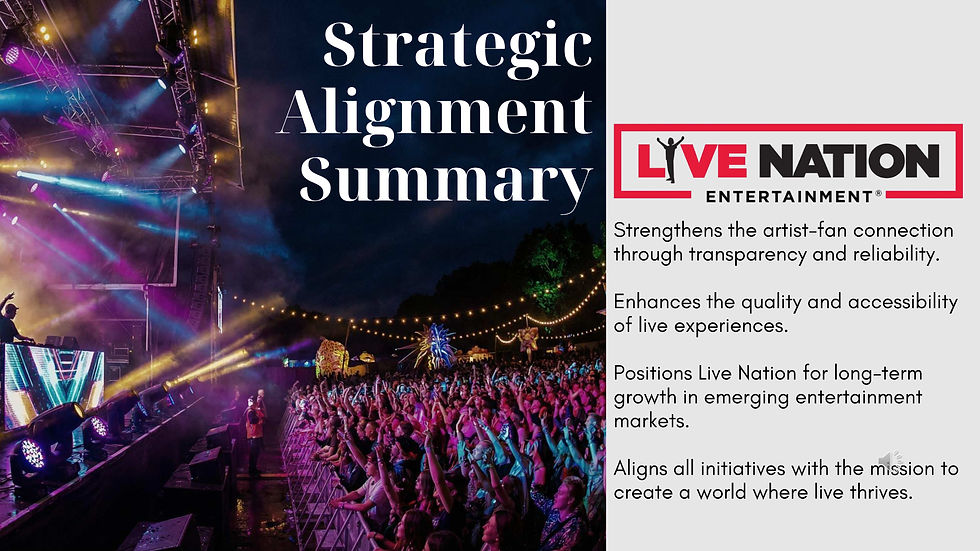
That meant a high-contrast palette of black, white, and a bold editorial red; serif display type for headlines paired with clean sans-serif body copy, the way a feature magazine pairs a dramatic masthead with readable column text; and full-bleed photography (crowd shots, concert lighting, archival ticket stubs) instead of clip art. Section openers like "SWOT Analysis," "Company Evaluation," and "Industry & Product Overview" got treated like magazine section headers, with oversized type doing the work that a plain title slide usually doesn't. The goal the whole way through was to make dense market research feel enticing without sacrificing how informative it was. Every visual choice still had to serve the data, not distract from it.
The sections I researched and wrote
Beyond the design work, I owned three of the analytical sections that tied the whole story together:
SWOT Analysis. I dug into what's actually working for Live Nation and what's working against it: its control of roughly 80% of major concert venues' primary ticketing and 265+ venues on the strength side, against a Ticketmaster Net Promoter Score of negative 62, the fallout from the Taylor Swift presale incident, and the 2024 breach that exposed over 40 million users' data on the weakness side. I also mapped the opportunities (the immersive entertainment market is projected to top $1 trillion by 2033) against the threats closing in, namely the DOJ's antitrust case and rising economic pressure on ticket prices.
Future Prospects & Recommendations. This is where the SWOT had to turn into an actual point of view. I framed Live Nation's path forward around six pillars: staying mission-driven, leaning into immersive and hybrid entertainment formats, expanding into global and corporate markets, rebuilding trust through ticketing reform, navigating regulatory and economic risk, and a set of strategic imperatives to tie it all together.
Action Plan. Strategy without a timeline is just opinion, so I broke the recommendations into immediate (zero to six months), short term (six to eighteen months), and long term (eighteen plus months) actions, from publishing transparent, all-in pricing and strengthening cybersecurity right away, to rebuilding platform infrastructure and investing in esports and VR/AR partnerships down the road.
What I took away from it
This project ended up being a good test of holding both halves of marketing strategy at once: the analytical rigor of building a defensible argument from real industry data, and the creative instinct to actually make people want to engage with it. The Gantt chart kept the team honest on time. The magazine concept made sure the work didn't just sit in a folder unread. Getting full marks on the report and presentation was a nice outcome, but the more useful skill was learning how to run a team project end to end, from timeline to template to thesis, and land all three in the same place.
See the presentation below




Comments